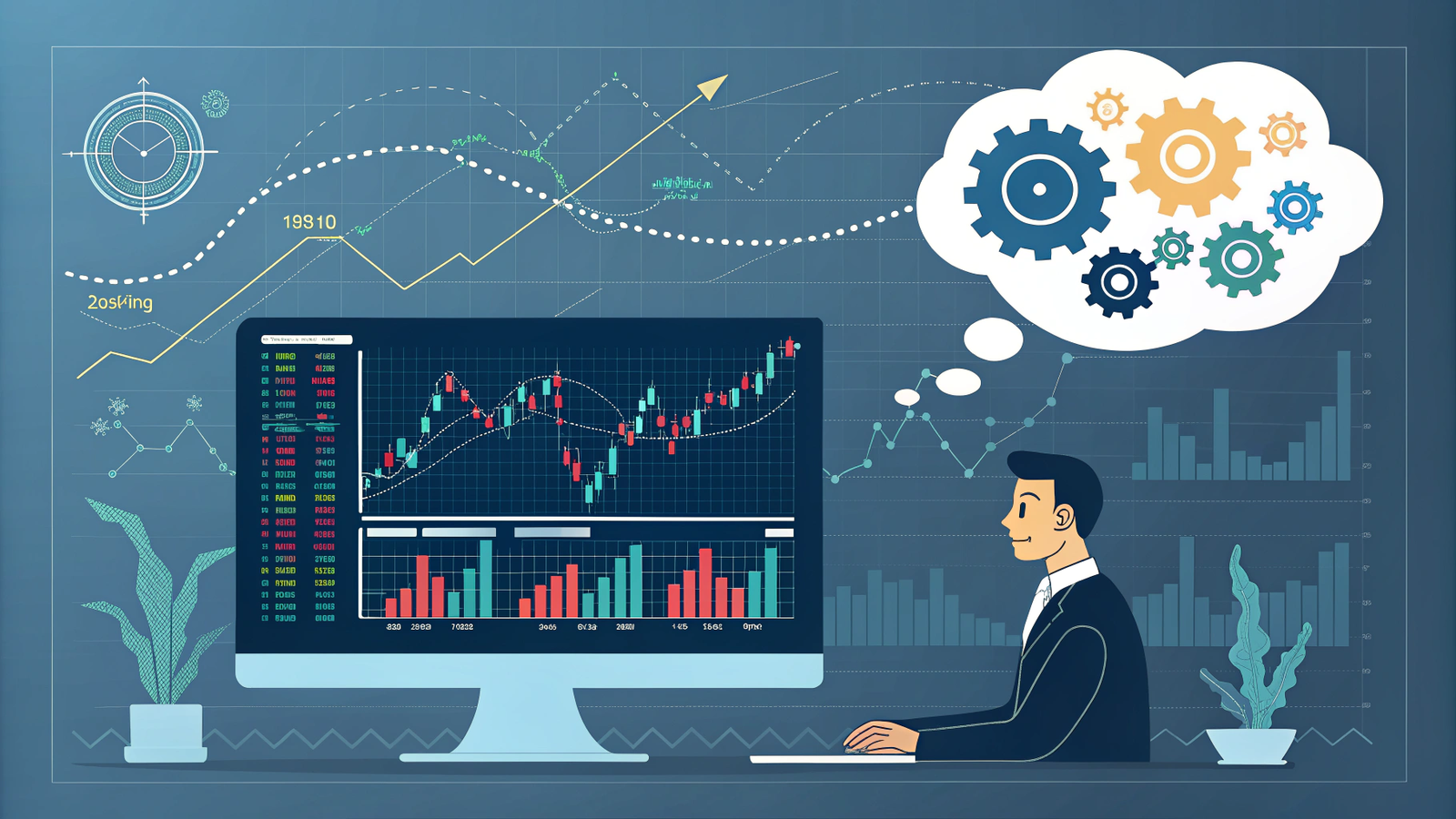
Every trader knows the feeling: watching a position move against you, palms sweating, mind racing between holding on for a reversal or cutting losses. That split-second decision, driven by fear or hope rather than data, has cost countless traders their capital. The market doesn’t care about your emotions—but your emotions profoundly affect how you trade.
AI trading eliminates emotional bias by executing strategies based purely on data and algorithms. Studies show 70-80% of retail traders lose money largely due to emotional decision-making, while automated systems maintain discipline 24/7, following predetermined rules without fear, greed, or fatigue affecting performance.
Understanding the psychology behind trading decisions—and why automation succeeds where human willpower fails—is essential for anyone seeking consistent returns in today’s volatile markets.
The Emotional Traps That Sabotage Trading Success
Human psychology evolved for survival, not for trading financial markets. Our brains are wired with cognitive biases that once protected us from predators but now undermine our trading performance. Recognizing these patterns is the first step toward overcoming them.
Fear and Greed: The Twin Destroyers of Capital
Fear causes traders to exit winning positions too early, leaving profits on the table. Greed makes them hold losing trades too long, hoping for an unlikely reversal. This asymmetric risk management—cutting winners short while letting losers run—is the opposite of profitable trading, yet it feels natural to our emotional brains.
The fear of missing out (FOMO) drives traders to chase momentum at market tops, buying high just before reversals. Conversely, panic selling at market bottoms locks in losses at the worst possible moment. These emotional trading patterns repeat across all asset classes, from stocks to forex to cryptocurrencies.
Cognitive Biases That Cloud Judgment
- Confirmation bias: Seeking information that supports existing positions while ignoring contradictory data
- Recency bias: Overweighting recent events and assuming current trends will continue indefinitely
- Loss aversion: Feeling losses approximately twice as intensely as equivalent gains, leading to irrational holding patterns
- Overconfidence: Overestimating trading abilities after a winning streak, leading to excessive risk-taking
- Anchoring: Fixating on entry prices or past highs rather than current market reality
These biases don’t disappear with experience. Professional traders with decades of experience still struggle with emotional discipline. The solution isn’t stronger willpower—it’s removing emotion from the equation entirely.
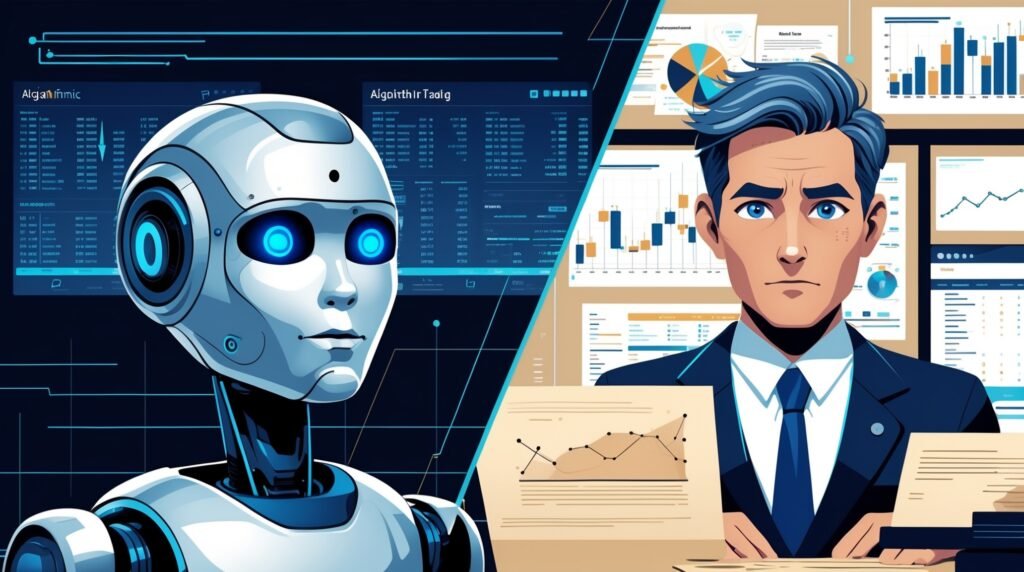
Why AI Trading Psychology Delivers Superior Results
Artificial intelligence doesn’t experience fear when markets plunge or greed when they rally. It processes market data, identifies patterns, and executes trades based on statistical probabilities rather than gut feelings. This fundamental difference in ai trading psychology creates measurable performance advantages.
Consistency Across Market Conditions
Human traders perform differently based on mood, stress levels, sleep quality, and external life factors. An argument before the trading session can subtly influence risk tolerance. A winning streak can breed overconfidence. These psychological variables introduce inconsistency that compounds over time.
Automated trading systems execute the same logic regardless of market conditions or external factors. The strategy that worked last month runs identically this month. This consistency allows for proper backtesting, performance measurement, and continuous optimization—impossible when human emotion introduces random variables into every decision.
24/7 Market Monitoring Without Fatigue
Forex markets trade around the clock. Cryptocurrency markets never close. Even stock markets across different time zones offer nearly continuous opportunities. Human traders cannot monitor markets constantly without severe fatigue degrading their decision quality.
AI systems analyze market conditions continuously, identifying opportunities and managing risk while you sleep. Platforms like BluStar AI operate specialized bots for gold, Bitcoin, and forex markets that never tire, never need breaks, and never make decisions based on exhaustion.
Instant Execution Without Hesitation
Hesitation costs money. When a stop-loss level is breached, every second of delay increases potential losses. When a high-probability setup appears, hesitation means missing the optimal entry. Human traders struggle with execution, second-guessing signals even when they know the right action.
Automated systems execute instantly when conditions are met. There’s no internal debate, no “let me wait one more candle,” no emotional override of the trading plan. This mechanical precision ensures that tested strategies perform in live markets as they did in backtests.
The Data Behind Automated Trading Performance
The advantages of removing emotion from trading aren’t theoretical—they’re measurable. Comparing human versus automated performance reveals consistent patterns across markets and timeframes.
| Performance Factor | Human Traders | Automated AI Systems |
|---|---|---|
| Emotional bias impact | High—affects every decision | Zero—purely data-driven |
| Strategy consistency | Variable based on psychology | Identical execution every time |
| Operating hours | Limited by human capacity | Continuous 24/7 monitoring |
| Reaction speed | Seconds to minutes | Milliseconds |
| Discipline during drawdowns | Often breaks under pressure | Maintains rules regardless |
| Learning from mistakes | Slow, ego-driven | Systematic optimization |
Research consistently shows that retail traders underperform market benchmarks primarily due to behavioral factors rather than lack of market knowledge. The information is available; the discipline to act on it rationally is what separates successful trading from costly emotional trading.
Real-World BluStar Results: Emotion-Free Trading in Action
Theory matters less than results. When traders implement automated systems that eliminate emotional decision-making, performance improvements become tangible. The blustar results demonstrate what happens when sophisticated algorithms replace gut feelings.
Traders using BluStar AI maintain full control of their funds through trusted brokerage partners while benefiting from AI-driven insights that operate independently of emotional states. The platform’s specialized bots for different markets—gold, Bitcoin, and forex—adapt dynamically to changing conditions without the psychological barriers that limit human traders.
The transparent performance tracking and intuitive dashboard allow users to observe how consistent, emotion-free execution performs across different market environments. During volatile periods when emotional traders panic-sell, automated systems continue following tested strategies. During euphoric bull runs when emotional traders over-leverage, AI maintains disciplined risk management.
Key Advantages of Emotion-Free Trading Systems
- Predefined risk parameters: Position sizing and stop-losses are determined by strategy, not fear levels
- No revenge trading: After losses, the system doesn’t try to “win it back” with larger, riskier positions
- Objective opportunity assessment: Every potential trade is evaluated by the same criteria without bias
- Continuous improvement: Performance data informs optimization without ego defending past decisions
- Stress-free trading experience: Users can step away from screens knowing the system operates according to plan
Implementing Automated Trading: Practical Steps Forward
Understanding why AI beats human emotion is valuable, but implementation determines results. Transitioning from emotional trading to automated systems requires a methodical approach.
Start by acknowledging your own emotional patterns. Keep a trading journal noting not just what you traded but how you felt during decisions. Most traders discover consistent emotional triggers that sabotage performance. Recognizing these patterns creates motivation to adopt systematic approaches.
Choose automation that matches your risk tolerance and market preferences. Not all AI trading systems are equal. Look for platforms offering transparent performance tracking, the ability to start, pause, or stop trading at any time, and specialization in markets you understand. Diversification across asset classes—combining forex, cryptocurrency, and commodity bots—reduces correlation risk.
Begin with capital you can afford to have at risk while the system proves itself to you psychologically. Even when intellectually convinced that automation outperforms emotional trading, most traders need time to build trust in the system. Starting with appropriate position sizing allows you to observe performance without anxiety undermining your commitment to the approach.
Monitor performance objectively, focusing on statistical measures rather than individual trades. Every trading system experiences losing trades and drawdown periods. Emotional traders abandon strategies during normal variance. Successful automated traders evaluate performance over meaningful sample sizes, understanding that consistency over months matters more than any single day’s results.
The evidence is clear: emotional trading is the primary obstacle between most traders and consistent profitability. Fear, greed, and cognitive biases aren’t character flaws—they’re human nature. The solution isn’t trying harder to overcome these psychological factors through willpower. It’s implementing systems that operate independently of them.
Artificial intelligence doesn’t replace the trader’s goals or risk parameters. It replaces the emotional interference that prevents executing those goals consistently. By combining deep-learning technology with real-time market analysis, modern automated trading solutions deliver the discipline that human psychology makes nearly impossible to maintain.
For traders seeking consistency and control, the path forward isn’t mastering emotions—it’s making them irrelevant to your trading results.
Disclaimer:
All information and features provided by this trading system are intended for entertainment purposes only and do not constitute financial or investment advice. Trading and investing in financial markets involve significant risk and can result in the loss of your funds. There is no guarantee of accuracy, performance, or profitability. Automated trading systems may experience errors, delays, or unexpected behavior. By using this system, you acknowledge that you are fully responsible for all trading decisions and potential losses. Always do your own research and trade at your own risk.