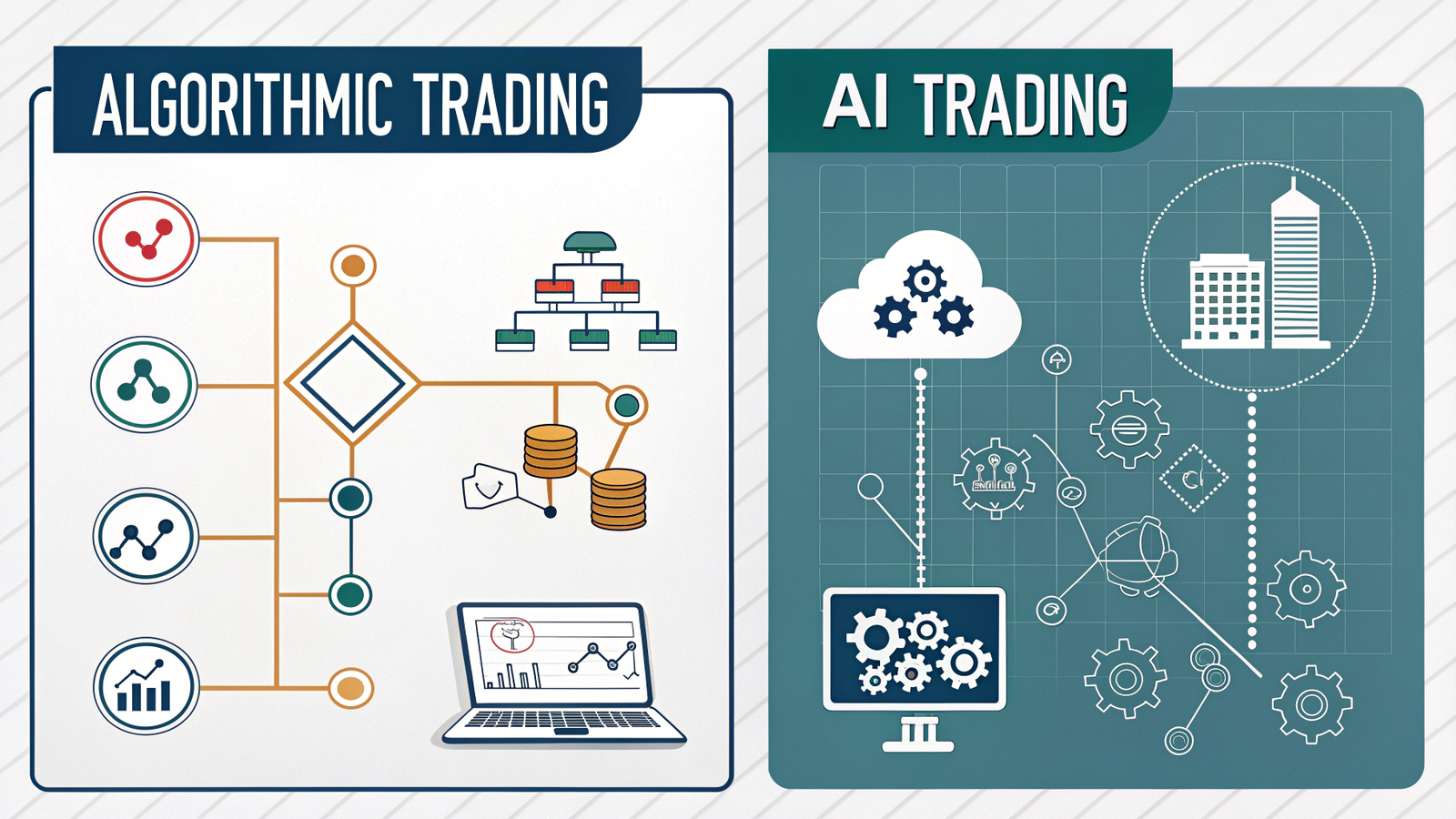
The rise of trading automation has transformed how investors approach financial markets. From Wall Street institutions to individual traders, automated systems now execute millions of trades daily. But when comparing algorithmic trading vs AI trading, many investors struggle to understand what truly separates these approaches—and which one aligns with their goals.
Algorithmic trading follows pre-programmed rules to execute trades based on fixed parameters like price, timing, and volume. AI trading uses machine learning to analyze data patterns, adapt to market changes, and improve decisions over time without manual reprogramming.
Understanding Algorithmic Trading
Algorithmic trading, often called algo trading, executes trades based on predetermined instructions. These systems follow explicit rules: if certain conditions are met, the algorithm triggers a buy or sell order. The approach has dominated institutional trading since the 1970s, when computerized systems first began automating order execution.
Traditional algorithmic trading relies on:
- Fixed mathematical models and technical indicators
- Rule-based logic (if-then conditions)
- Historical backtesting to validate strategies
- Consistent execution without emotional interference
- Speed advantages over manual trading
These systems excel at executing high-frequency trades and capturing small price discrepancies across markets. However, they require manual updates when market conditions shift fundamentally. A rule that worked during low volatility may fail during market turbulence unless a developer modifies the code.
How AI Trading Differs
AI trading represents an evolutionary leap in trading automation. While algorithmic systems follow static rules, AI-powered platforms use machine learning and deep learning to recognize complex patterns, adapt to new market conditions, and refine their strategies autonomously.
The key technological differences include:
- Learning capability: AI models improve performance by analyzing outcomes and adjusting parameters
- Pattern recognition: Neural networks identify non-linear relationships humans might miss
- Dynamic adaptation: Systems respond to changing volatility, correlations, and market regimes
- Multi-factor analysis: AI processes vast datasets including news sentiment, social media, and macroeconomic indicators
- Predictive modeling: Machine learning forecasts price movements rather than just reacting to them
Platforms like BluStar AI exemplify this approach by combining deep-learning technology with real-time market analysis. Their specialized bots for gold, Bitcoin, and forex markets continuously adapt to market dynamics without requiring manual strategy adjustments.
Algorithmic Trading vs AI Trading: Direct Comparison
| Feature | Algorithmic Trading | AI Trading |
|---|---|---|
| Decision Logic | Rule-based, fixed parameters | Learning-based, adaptive models |
| Adaptation | Requires manual reprogramming | Self-adjusts to market changes |
| Data Processing | Limited to predefined inputs | Analyzes vast, diverse datasets |
| Pattern Recognition | Linear, explicit patterns | Complex, non-linear relationships |
| Maintenance | High (constant updates needed) | Lower (autonomous learning) |
| Market Conditions | Performs best in stable environments | Adapts across various regimes |
| Transparency | Fully explainable logic | Can be “black box” depending on model |
Advantages of Traditional Algorithmic Trading
- Complete transparency in decision-making logic
- Easier regulatory compliance and audit trails
- Lower computational requirements
- Predictable behavior in tested scenarios
- Simpler to understand for non-technical users
Advantages of AI Trading Systems
- Superior adaptability to evolving market conditions
- Ability to process alternative data sources (news, sentiment, economic indicators)
- Continuous improvement through machine learning
- Detection of subtle patterns invisible to rule-based systems
- Reduced need for constant human intervention

Which Approach Suits Your Investment Strategy?
The choice between algorithmic trading vs AI trading depends on your specific circumstances, risk tolerance, and involvement level. Traditional algorithms may suit traders who:
- Prefer complete transparency in every trading decision
- Trade in highly regulated environments requiring explainable logic
- Focus on specific, well-defined strategies like arbitrage
- Have programming expertise to maintain and update systems
AI trading platforms better serve investors who:
- Want 24/7 automated trading without constant supervision
- Seek systems that adapt to volatile or changing markets
- Lack time or expertise to manually adjust trading strategies
- Value performance optimization over complete decision transparency
- Trade across multiple asset classes with different characteristics
Modern solutions like BluStar AI democratize sophisticated AI-driven trading by making it accessible to both seasoned investors and newcomers. Users maintain full control of their funds through trusted brokerage partners while benefiting from continuous AI-driven insights—eliminating the emotional decision-making that often undermines manual trading.
The Future of Trading Automation
The distinction between algorithmic trading vs AI trading will likely blur as technologies converge. Hybrid systems are emerging that combine rule-based safety controls with machine learning optimization. This approach offers the transparency and predictability of algorithms with the adaptive intelligence of AI.
Key trends shaping trading automation include:
- Explainable AI: New techniques make machine learning decisions more transparent and interpretable
- Reinforcement learning: AI agents that learn optimal strategies through trial and error in simulated environments
- Alternative data integration: Systems that incorporate satellite imagery, credit card transactions, and other non-traditional indicators
- Democratization: User-friendly platforms bringing institutional-grade technology to retail investors
- Risk management AI: Intelligent systems that dynamically adjust position sizing and exposure
For investors evaluating blustar invest options or similar AI-driven platforms, the focus should be on track records, risk management protocols, and transparency in performance reporting rather than getting caught up in technological buzzwords.
Key Takeaways
- Algorithmic trading executes pre-programmed rules, while AI trading learns and adapts autonomously
- Traditional algorithms offer transparency; AI systems provide superior adaptability
- Neither approach is universally superior—the right choice depends on your specific needs
- Modern AI trading platforms make sophisticated automation accessible to individual investors
- The future likely involves hybrid systems combining both approaches’ strengths
- Evaluate any automated trading solution based on performance data, risk controls, and alignment with your investment goals
Understanding the real differences between algorithmic trading vs AI trading empowers you to choose automation tools that match your investment philosophy. Whether you opt for rule-based consistency or adaptive intelligence, trading automation removes emotional bias and enables systematic execution—giving you back time while keeping you connected to market opportunities.